BIO
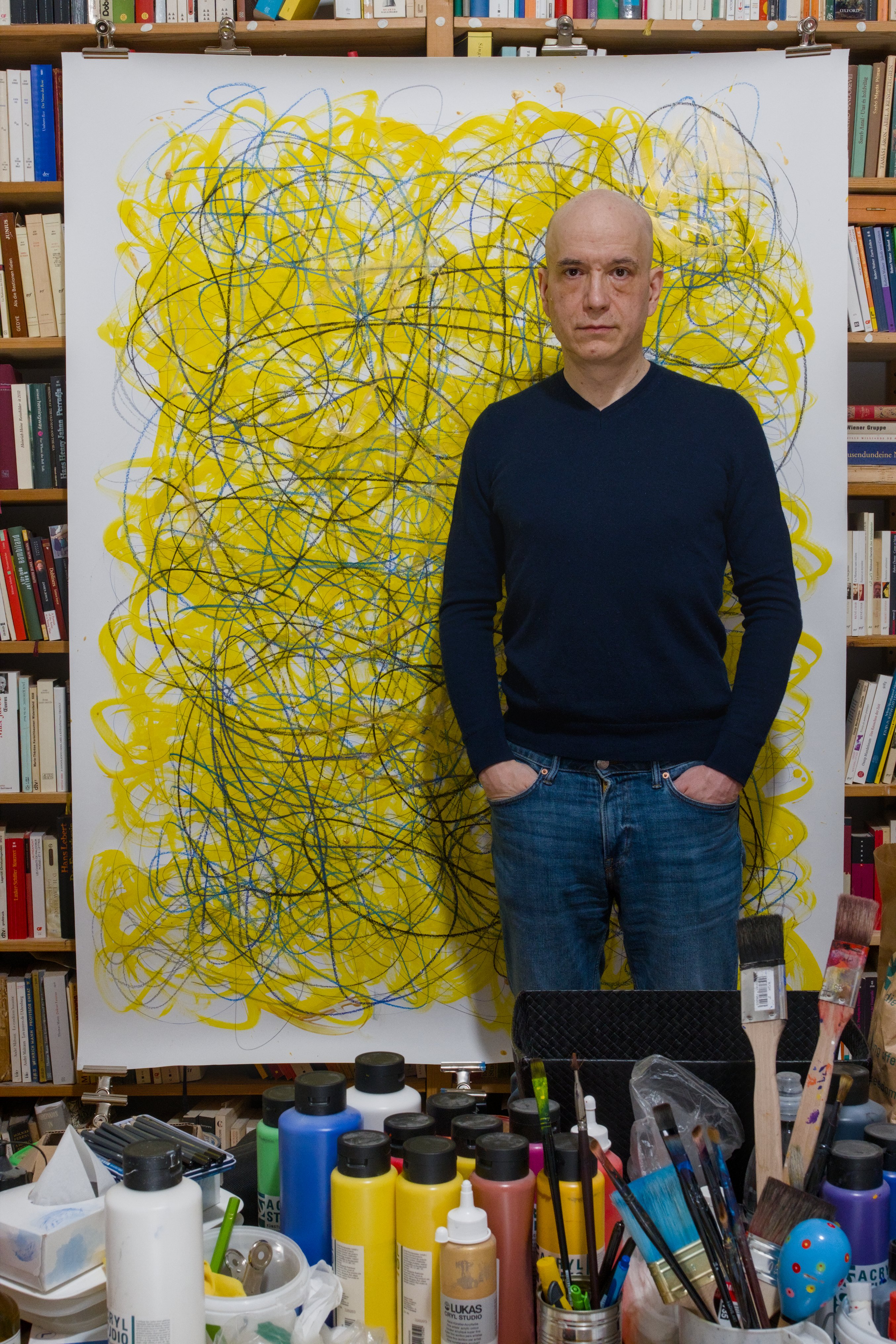
Born in 1971, into an Austro-Hungarian family, Shaye Weiss began painting and drawing as a teenager. In the 1990s, he studied art, philosophy and cinema at the University of Paris VIII, Vincennes-Saint-Denis, where notable figures such as Jacques Rancière, Gilles Deleuze, Michel Foucault, Hélène Cixous and Jean-François Lyotard had taught. He undertook doctoral research on the aesthetics of resistance in the films of Jean-Marie Straub and Danièle Huillet.
Following several detours, including spending seven years in Bnei Brak, Israel, where he worked as a photographer and immersed himself in Hasidic tradition and Jewish mysticism, he returned to Vienna, where he currently lives and works.
His painting and drawing practice is rooted in what he identifies as neo-abstract expressionism and neo-gestural abstraction. His work draws on distinct yet related influences: the painterly confidence of Joan Mitchell; the urgency of Dubuffet's scratch marks; the obsessive scribblings of Cy Twombly; the graffiti urgency of Basquiat; the intuitive overpainting of Arnulf Rainer; and the socially charged surfaces of Oscar Murillo. Each of these influences matters for different reasons.
The mark-making process is full-body, explosive and fast. The gestures are automatic and spontaneous, yet the physical conditions under which they occur - the tools, materials, scale and surface - are deliberately chosen. The works document these performances. There is no hidden meaning. Everything is in plain sight: the marks, the colours, the collisions between them, and the cultural significance of the shapes that the hand repeatedly returns to.
Recurrent themes include anti-Semitism, depression, anxiety and death. Materiality is not a vehicle for these themes. It is where they reside.